
Discover why pain management billing claims get denied in 2026 and learn proven strategies to fix them fast and protect your revenue.
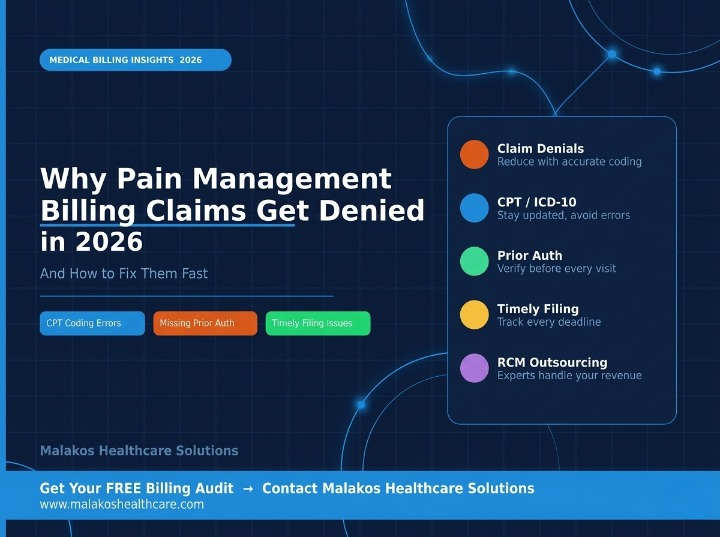
Why Pain Management Billing Claims Get Denied in 2026 (And How to Fix Them Fast)
Pain management is one of the most procedure-intensive specialties in medicine. From epidural steroid injections to spinal cord stimulation, interventional pain specialists perform complex, high-value procedures every single day. And that complexity doesn’t stop at the clinical level — it carries straight into the billing office.
Payers like Medicare, Medicaid, and commercial insurers scrutinize pain management claims more than almost any other specialty. Strict medical necessity requirements, evolving CPT codes, prior authorization rules, and aggressive audit activity make pain management billing a minefield for even experienced billing teams.
The result? Denied claims. Delayed reimbursements. Revenue walking right out the door.
If your pain clinic is seeing higher denial rates in 2026, you’re not alone — and more importantly, you’re not stuck. In this article, we break down exactly why claims get denied and what you can do to fix them fast.
Common Challenges in Pain Management Billing
Before we dive into specific denial reasons, it helps to understand why pain management billing is uniquely difficult. This isn’t a simple E&M-heavy specialty — it involves layered procedures, bundling rules, and intensive documentation requirements.
Complex CPT Coding for Injections and Procedures
Pain management procedures — including nerve blocks, facet joint injections, trigger point injections, and radiofrequency ablations — require very precise CPT code selection. A single procedure can involve multiple codes, imaging guidance add-ons, and bilateral modifiers. Getting any one of them wrong means a denial.
Strict Documentation Requirements
Payers demand detailed documentation proving medical necessity for nearly every pain management procedure. That means prior treatment history, failed conservative therapies, functional limitations, and clinical findings — all clearly documented in the chart notes.
Authorization Requirements
Most commercial insurers require prior authorization for interventional pain procedures. Missing an auth — or billing a procedure that wasn’t covered under the approved auth — is one of the fastest ways to guarantee a denial.
Frequent Audits and Compliance Risks
Pain management practices are frequently targeted by RAC (Recovery Audit Contractor) and OIG audits. Without a proactive compliance program, a single audit can trigger large-scale claim reviews and costly paybacks.
High Denial Rates Across the Board
Across the industry, pain management practices report some of the highest claim denial rates among specialty practices. Many of these denials are preventable — but only if you know exactly where the breakdowns are happening.
Top Reasons Pain Management Claims Get Denied in 2026
Let’s get specific. Here are the most common denial triggers in pain management billing right now:
1. Incorrect CPT or ICD-10 Coding
Pain management has seen significant CPT code updates in recent years. Using an outdated code, selecting the wrong level of service, or mismatching the ICD-10 diagnosis code to the procedure will almost always result in a denial or a reduced payment. This is especially common with injection codes, where laterality and imaging guidance change the code entirely.
2. Missing or Incomplete Documentation
When a payer audits a claim, they’re looking for documentation that supports everything you billed. If the notes don’t clearly establish medical necessity — or if the procedure report is missing key details like fluoroscopy use, contrast injection, or patient positioning — the claim gets denied. Incomplete progress notes are one of the leading causes of medical billing for pain management going sideways.
3. Lack of Prior Authorization
Prior auth requirements are stricter than ever in 2026. Some payers now require authorization for procedures that were once routinely covered. If your team is working from an outdated authorization checklist — or missing the auth altogether — you’re leaving significant revenue on the table.
4. Timely Filing Violations
Every payer has a filing deadline — often 90 to 365 days from the date of service. When claims fall through the cracks due to understaffing or poor tracking, they get filed late. Payers don’t make exceptions for administrative oversights, and timely filing denials are almost impossible to appeal successfully.
5. Modifier Misuse
Modifiers are critical in interventional pain billing. Modifier 50 (bilateral), -59 (distinct procedural service), -RT/-LT (laterality), and -26 (professional component) are all commonly misapplied. Using the wrong modifier — or forgetting to append one — leads to denials, bundling errors, or incorrect payment amounts.
How to Fix These Issues — Practical Solutions That Work
The good news? Most of these denial causes are preventable. Here’s a practical roadmap to getting your pain management billing back on track:
Build a Solid Documentation Workflow
Work with your physicians to create standardized procedure note templates that capture every piece of documentation payers expect to see. Make it easy for providers to document medical necessity in the flow of their normal charting — not as an afterthought.
Invest in Specialty-Specific Coder Training
Pain management coding is its own discipline. Make sure your billing staff or coders are trained specifically in interventional pain billing — not just general medical coding. Annual training on CPT code updates, payer-specific policies, and modifier rules is essential.
Verify Eligibility and Authorization Before Every Appointment
No patient should walk into a procedure without confirmed insurance eligibility and, where required, prior authorization. Build a pre-visit verification process that checks both — and flags any discrepancies before the day of service.
Implement a Denial Tracking System
You can’t fix what you don’t measure. Track denials by payer, denial reason, procedure type, and provider. When you identify patterns — for example, a specific payer consistently denying a certain injection code — you can address the root cause proactively instead of fighting individual appeals.
Conduct Regular Billing Audits
Internal audits catch problems before they become systemic. Review a sample of your claims monthly — looking at coding accuracy, documentation quality, and authorization compliance. Catching errors internally is always better than having a payer catch them during an external audit.
Why Outsourcing Pain Management Billing Makes Sense
Running a high-performing billing operation for a pain management practice takes dedicated expertise, ongoing training, and the right technology. For many practices, outsourcing pain management billing services to a specialty-focused revenue cycle management (RCM) partner is the most efficient and effective solution.
Here’s what the right RCM partner for pain management brings to the table:
- Faster reimbursements — experienced billers know how to submit clean claims the first time, reducing the back-and-forth that slows down payment.
- Reduced denials — specialty-trained coders who understand interventional pain billing minimize preventable errors.
- Compliance assurance — a dedicated compliance team keeps your practice aligned with CMS guidelines and payer policies, reducing audit risk.
- Better cash flow — with fewer denials, faster processing, and proactive follow-up on outstanding claims, your practice sees steadier, more predictable revenue.
- More time for patient care — when your team isn’t buried in billing issues, they can focus on what matters most.
Get Your FREE Pain Management Billing Audit
Is your practice leaving revenue on the table? Our billing specialists will review your claims process, identify gaps, and show you exactly where you can recover lost revenue — at no cost to you.
Contact Malakos Healthcare Solutions today. Visit: www.malakoshealthcare.com
Conclusion: Accurate Billing Is the Lifeblood of Your Pain Practice
Pain management billing is complex — but complexity doesn’t have to mean constant denials and lost revenue. The practices that thrive are the ones that treat billing as a clinical discipline in its own right: with precision, ongoing training, and a commitment to getting it right the first time.
Whether the issue is incorrect CPT coding, documentation gaps, missing authorizations, or modifier errors, every denial has a root cause — and every root cause has a solution. Start with visibility: track your denials, audit your claims, and identify where your revenue cycle is breaking down.
And if managing all of this in-house is stretching your team thin, remember that specialized pain management billing services exist for exactly this reason. The right RCM partner doesn’t just process claims — they protect your revenue, reduce your risk, and give you the financial stability to focus on your patients.
In 2026, the practices that master their billing will be the ones that thrive. Don’t let preventable denials stand between you and the revenue your practice has earned.
© 2026 Malakos Healthcare Solutions | Specialized RCM for Pain Management PracticesShare
Get Free Billing Audit