

You’re seeing patients every day. Claims are going out through Medical Billing. But at the end of the month, the numbers don’t add up.
Sound familiar?
Most practices are losing revenue silently — not because of bad care, but because of gaps in three core billing functions: claim submission, payment posting, and insurance collections. The problem isn’t always visible. That’s what makes it dangerous.
Delays, denials, underpayments, and aging AR don’t send you an alert. They just quietly shrink your collections — month after month.
If you’ve ever asked yourself “why are my insurance payments so low?” or “why are so many claims getting denied?” — this post is for you.
Why Are My Claims Getting Denied So Often? (Medical Billing)
What a Clean Claim Actually Means — and Why It Matters
The claim submission process is where your revenue cycle either gains momentum or loses it. A “clean claim” means every piece of information on that claim is accurate, complete, and submitted on time. When that happens, payers have no reason to delay or deny — and your first-pass acceptance rate stays high.
The industry benchmark for clean claims is 95% or above. If yours is lower, denials are piling up before revenue even has a chance to come in.
What Causes Claims to Get Rejected or Denied?
These are the most common reasons practices lose money at the submission stage:
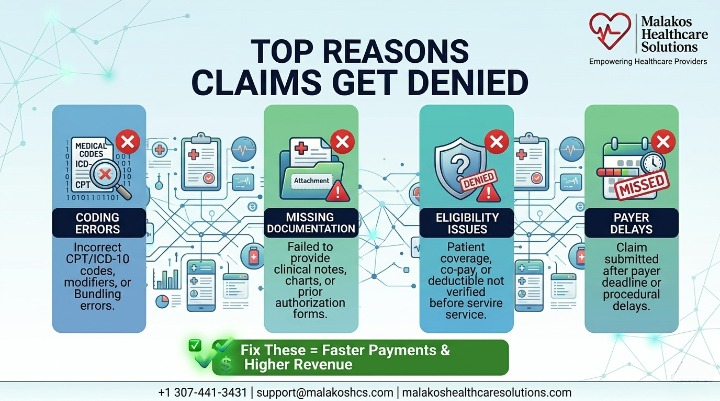
- Wrong or mismatched patient information — name, date of birth, or insurance ID doesn’t match payer records
- Incorrect diagnosis or procedure codes — ICD-10 or CPT errors that don’t support medical necessity
- Missing modifiers — without the right modifier, payers won’t process the claim correctly
- Eligibility not verified before the visit — patient’s coverage has lapsed or changed
- Late submissions — claim filed after the payer’s timely filing deadline, with no chance of appeal
Every denied claim means your team has to stop, investigate, correct, and resubmit — or write it off entirely. That’s time and money your practice can’t afford to lose.
Quick win: Run eligibility verification before every appointment, not just for new patients. Insurance changes happen constantly, and one lapsed policy can mean a $300+ denial.
How Do I Know If My Insurance Payments Are Correct?
What Is Payment Posting in Medical Billing — and Why Should You Care?
When an insurance company processes your claim, they send back either an ERA (Electronic Remittance Advice) or an EOB (Explanation of Benefits) along with the payment. Payment posting in medical billing is the process of recording those payments accurately in your system.
Most practices treat this as a data entry task. That’s a costly mistake.
Are You Getting Paid Less Than You’re Supposed To?
Here’s a real-world scenario that happens in practices every day:
A claim goes out for $350. The insurance pays $190. The biller posts it, marks it closed, and moves on. But your contracted rate for that service is actually $230. That’s $40 in missed revenue — on one single claim. If this happens on 200 claims a month, you’ve quietly lost $8,000.
Accurate payment posting means your team is:
- Comparing every payment against your contracted fee schedule to catch underpayments
- Distinguishing contractual adjustments from actual patient responsibility — these are not the same
- Flagging denied line items instead of quietly writing them off
- Reconciling ERA/EOB totals with actual bank deposits to catch discrepancies
Payment posting isn’t just bookkeeping. It’s where underpayments either get caught — or disappear forever.
How Do I Collect Money from Insurance Companies That Aren’t Paying?
What Does AR Follow-Up in Medical Billing Actually Look Like?
No matter how clean your claims are, some will not be paid on the first submission. Payers delay. Payers deny. Payers underpay. That’s why AR follow-up in medical billing exists — to chase down every unpaid or underpaid claim and recover what your practice is owed.
Insurance collections in medical billing is not passive. It requires daily, structured follow-up — by payer, by aging bucket, and by denial reason.
Why Does It Get Harder to Collect the Longer You Wait?
Because claims age out. The older a claim gets, the harder — and sometimes impossible — it becomes to collect.
An AR aging report with a large percentage of balances in the 90+ day bucket is a serious warning sign. It often means claims were never followed up, denial appeals were never filed, or timely filing deadlines have already passed.
Effective insurance collections means:
- Following up on unpaid claims within 30 days of the original submission
- Appealing denied claims with supporting documentation and clinical notes
- Spotting denial patterns — same payer, same code, same reason — and fixing the root cause
- Resubmitting corrected claims promptly instead of letting them age
- Never accepting an underpayment without justification from the payer
The bottom line: Every dollar sitting in your AR is money your practice has already earned. The only question is whether you’ll collect it.
How Do Claim Submission, Payment Posting, and Collections Work Together?
Why One Weak Area Can Break Your Entire Revenue Cycle
These three functions don’t operate in isolation. They’re connected stages of the same revenue pipeline, and a problem in any one of them creates a chain reaction.
Here’s what that looks like:
- Sloppy claim submission → more denials → heavier AR workload → collections team overwhelmed → revenue delayed or lost
- Inaccurate payment posting → underpayments go unnoticed → revenue permanently written off
- No structured collections process → claims age past filing limits → practice forced to write off collectable balances
When all three work together — accurate submissions, careful posting, and proactive follow-up — your practice runs at maximum revenue efficiency.
Think of it this way: submission gets you in the door. Posting tells you what happened. Collections makes sure you actually get paid.
Where Exactly Is My Practice Losing Money Without Realizing It?
The Most Common Revenue Leakage Points in Medical Billing
Revenue leakage rarely looks like one big loss. It’s dozens of small ones, adding up quietly every month. Here are the most common places it happens:
- Underpayments never caught — payments posted without comparing to contracted rates
- Unpaid claims that age out — nobody followed up, and now the filing window is closed
- Wrong adjustments applied — amounts written off as “contractual” that were actually collectible
- Claims submitted late — missed filing deadlines mean automatic denial with no appeal option
- Denials accepted as final — team assumes the payer is right instead of filing an appeal
- No denial trend analysis — the same mistake keeps causing the same denial, month after month
If any of these sound familiar, a billing audit can tell you exactly how much revenue you’re leaving on the table.
What Can I Do Right Now to Improve My Practice’s Medical Billing and Collections?
Practical Steps to Strengthen Your Revenue Cycle in 2026
Fixing your revenue cycle doesn’t require a complete overhaul. It requires fixing the right things in the right order. Here’s where to start:
1. Fix the Front End First Most revenue problems start before the claim is even submitted. Prioritize eligibility verification, documentation accuracy, and coding review at the point of care — not after the denial arrives.
2. Train Your Team to Catch Underpayments Every payment posted should be compared to your contracted fee schedule. If your billing team isn’t doing this, you’re approving underpayments by default.
3. Work AR by Priority, Not Just by Date Segment your AR by payer, aging bucket, and denial reason. High-dollar claims approaching filing deadlines should always be worked first.
4. Review Key Metrics Every Month At minimum, track your:
- Clean claim rate
- First-pass acceptance rate
- Denial rate by payer
- AR aging (30 / 60 / 90+ days)
You can’t improve what you don’t measure.
5. Don’t Let Technology Replace Clinical Judgment Billing software speeds up workflows, but it doesn’t understand payer-specific rules, catch nuanced underpayments, or write winning appeal letters. The highest-performing practices combine smart technology with experienced billing professionals.
What Should I Do If My Practice Revenue Has Been Declining?
The Answer Starts With Looking at Your Revenue Cycle — Not Just Your Patient Volume
If your collections are down, the instinct is often to see more patients. But if your billing process is leaking revenue, more volume just means more leakage.
The medical billing revenue cycle is the financial foundation of your practice. Insurance collections in medical billing, accurate payment posting, and a reliable claim submission process are not back-office tasks. They are the system that converts your clinical work into actual revenue.
Practices that grow in 2026 won’t just work harder. They’ll build billing systems that work smarter — catching errors earlier, following up faster, and leaving nothing uncollected.
Start by asking the right questions: Is your clean claim rate above 95%? Are underpayments being tracked? Is your AR team working every denial, or just the easy ones?
The answers will tell you exactly where to focus.
Not sure where your revenue is leaking? A billing audit can identify exactly where your claim submission, payment posting, or insurance collections process is falling short — and give you a clear path to recover what you’re owed. It’s one of the highest-return steps a practice can take.