
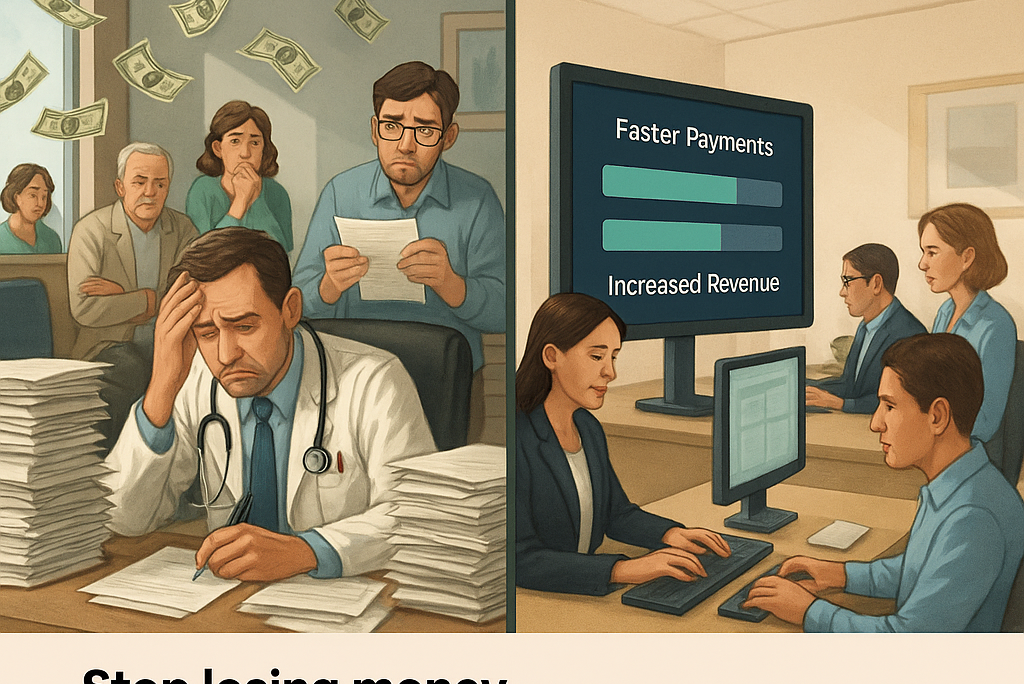
Do You Know Why Physical Therapy Practices Are Leaving Thousands on the Table Every Month, its not because they do not know about Medical Billing process, the reason is lack of follow up & understanding payer trends, their policies. And here we as a Medical Billing partner help provider updated with current law, regulation & policies of payers, so providers don’t loose money on the table. There is a version of underpayment in physical therapy that nobody talks about not because it’s rare, but because it’s invisible.
It doesn’t look like a denial. It doesn’t trigger an alert in your practice management system. It doesn’t generate a patient complaint. The money arrives. It just arrives short. And because something did arrive, nobody questions whether the correct amount arrived.
This is the revenue problem that affects the majority of outpatient physical therapy practices in the United States right now and it compounds quietly for months or years before someone finally measures it.
Physical therapy practices are losing thousands of dollars per month to payer underpayments and absent follow-up workflows. Not because their billing teams are incompetent. Because underpayment recovery requires a billing function that most PT practices simply haven’t built one that treats every payment as a question to be verified, not a transaction to be recorded.
This post covers where the money goes, why it keeps going, and what stopping the leak actually requires.
What Payer Underpayment Actually Looks Like in PT Billing
When a payer processes a physical therapy claim, the remittance shows three numbers: the billed amount, the allowed amount, and the paid amount. The difference between allowed and paid is recorded as a contractual adjustment and written off.
In most PT billing operations, this workflow ends there. The adjustment is posted. The balance zeros out. The claim is closed.
What never happens: someone checks whether the allowed amount matches the contracted rate.
Your payer contract specifies the exact rate your practice will receive for every CPT code. When the payer pays less than the contracted rate through incorrect adjustment codes, multiple procedure reductions applied above the contracted percentage, or bundled payment for services that should pay separately — the difference is an underpayment. It is your money. It is contractually owed. And it is recoverable through a formal dispute process.
But only if someone identifies it. And in practices without a contracted rate reconciliation workflow, nobody does.
The most common PT underpayment categories:
Multiple procedure reductions above contracted percentage. When a PT bills two or more timed services in a single session which is standard payers apply a reduction to secondary services. The contracted reduction percentage is specified in your payer agreement. When a payer applies 60% when your contract says 50%, that 10% difference is an underpayment on every multi-service session. In a practice billing two timed services per session on average, across 30 patients per day, this adds up to thousands of dollars per month written off as a standard contractual adjustment because nobody is comparing the reduction to the contract.
CQ-modified services paid below the 85% floor. Medicare reimburses PTA-rendered services at 85% of the PT fee schedule rate. Some Medicare Advantage plans apply different reduction percentages to CQ-modified services than the standard 85%. When a plan pays 75% instead of 85% on CQ-modified units, the 10% difference is an underpayment and it affects every PTA-rendered service billed to that plan.
Bundled payment on separately billable same-day services. When a PT bills an evaluation (97162) and a treatment (97110) on the same date, both are separately reimbursable. Some payers bundle the evaluation into the treatment payment despite correct billing paying as if only one service was rendered. The unbundled E/M is effectively paid at zero, with no denial notice, just a payment that looks complete until someone checks the line-item payment amounts against what should have been paid for each code separately.
Fee schedule applied below contracted rates. Payer contracts are updated periodically. When a contract is renegotiated upward and the payer’s internal fee schedule isn’t updated correctly, claims continue processing at the old rate. The practice’s billing system accepts the payment because it’s within a familiar range. Nobody compares it to the new contracted rate. The practice collects below contract for months until the discrepancy is identified if it ever is.
The AR Follow-Up Problem – Denied Claims That Nobody Pursues
Underpayments are one side of the revenue leak. The other side is denial revenue that ages into write-offs because no one followed up.
Physical therapy denials are common. The reasons vary authorization issues, medical necessity questions, unit count errors, missing modifiers, timely filing edge cases. What’s consistent across most PT practices is that denied claims receive inadequate follow-up, particularly as they age.
Here is the operational reality in most PT billing operations:
New claims get submitted on time. Denials that come back in the first 30 days get some attention easy fixes, quick resubmissions, simple corrections. But denials that require documentation packages, clinical record retrieval, formal appeal letters, or peer-to-peer review coordination sit in the queue. Tomorrow. Next week. After the month-end rush.
The payer’s appeal window doesn’t care about the billing team’s workload. Most commercial payers allow 60–180 days from the denial date to file an appeal. When that window closes, the denial is permanent. The claim cannot be recovered regardless of clinical merit, coding accuracy, or contractual entitlement.
What the aging PT AR typically looks like when we audit a practice:
The 0–30 day bucket reflects pending adjudication normal and expected. The 31-60 day bucket has claims beginning to require active follow-up some getting it, some not. The 61-90 day bucket is where the problem becomes visible: denied claims with appeal windows still open, sitting unworked because the billing team’s capacity went to newer, easier claims first. The 91–120 day bucket has claims at serious timely filing and appeal window risk some already past recovery. The 120+ day bucket is the graveyard: claims that should have been appealed months ago, written off during AR cleanup, recorded as bad debt.
The dollar amounts in the 61–120 day buckets of most PT practices represent recoverable revenue. Not certain recovery but recoverable, with the right documentation and the right appeal. By the time they hit the 120+ bucket, they’re gone.
Why This Keeps Happening – The Structural Problem
Both underpayment acceptance and inadequate AR follow-up share a common root cause: physical therapy billing requires more active management than the billing workflows in most PT practices are designed to provide.
Payment posting without reconciliation is the default. Most PT EHR and practice management systems post ERA payments automatically or with minimal manual review. The auto-posting is convenient. It’s also how underpayments disappear. Unless someone is actively comparing auto-posted payments against contracted rates, the system records whatever the payer sent as the correct amount.
AR follow-up is volume-driven, not value-driven. Most billing teams work AR queues in the order claims appear oldest first, or newest first, or by patient name. High-value denied claims don’t get more attention than low-value ones. A $400 denied therapeutic exercise claim and a $2,800 denied evaluation plus treatment same-day claim both sit in the queue. The $2,800 claim isn’t worked first because nobody has built the workflow to prioritize it.
Denied claims compete with new claim processing for the same staff time. A billing person responsible for entering charges, submitting claims, posting payments, and following up on denials can’t do all four well simultaneously in a busy practice. When new claims have to go out, denial follow-up waits. When denial follow-up waits long enough, appeal windows close.
Nobody is tracking payer behavior systematically. Underpayment patterns a specific payer consistently reducing secondary services above contracted rates, a Medicare Advantage plan applying incorrect CQ reduction percentages only become visible when someone is tracking payment variance by payer over time. Most PT practices aren’t. The pattern runs until someone looks for it.
What Underpayment Recovery Actually Requires (Physical Therapy Practices Are Leaving Thousands on the Table Every Month)
Recovering underpayments and pursuing denied claims correctly isn’t complicated in concept. It requires four things that most PT billing operations don’t currently have in place:
A contracted rate reference by payer and CPT code. Every time a payment is received, it needs to be compared to the contracted rate for that specific code and payer. This requires having the contracted rate accessible not just knowing roughly what a payer pays. Payer contracts and fee schedules need to be maintained as a billing reference, not filed away after credentialing.
A payment variance workflow at posting. Before any contractual adjustment is written off, the payment needs to be verified against the contracted rate. Variances payments below contracted rates, multiple procedure reductions above contracted percentages need to be flagged for dispute rather than written off automatically. This step takes additional time at posting. It recovers money that would otherwise be permanently lost.
A value-prioritized AR follow-up system. Denied claims need to be worked by value, not just by age. A $3,000 denied evaluation and treatment same-day claim should trigger immediate follow-up. A $90 denied hot pack claim can wait. Building value thresholds into the AR workflow ensures that high-dollar denials get the attention they need before appeal windows close.
Formal appeal capability with clinical documentation support. Many PT denials particularly medical necessity denials and authorization-related denials require formal written appeals with supporting clinical documentation. Corrected resubmission isn’t enough. A billing team that can only resubmit claims, not prepare and file formal appeals with progress notes and functional outcome documentation, leaves a significant category of denial revenue permanently on the table.
What the Dollar Gap Looks Like
For a two-therapist outpatient PT practice billing approximately 1,200 patient encounters per month with a typical commercial and Medicare payer mix, the combined annual revenue gap from underpayment acceptance and inadequate AR follow-up typically runs:
| Revenue Gap | Annual Estimated Impact |
|---|---|
| Multiple procedure reductions above contracted rate | $18,000 – $28,000 |
| Bundled same-day evaluation + treatment payments | $12,000 – $20,000 |
| Fee schedule discrepancies not identified | $8,000 – $15,000 |
| Denied claims not appealed before window closes | $24,000 – $42,000 |
| Authorization gap denials accepted without challenge | $14,000 – $22,000 |
| Total | $76,000 – $127,000 |
These numbers are conservative. They don’t include practices where the payer contract hasn’t been audited recently, where CQ reduction percentages haven’t been verified against the contract, or where the AR aging has significant buildup in the 90–120 day buckets from a backlog of unworked denials.
The practices with the largest gaps are almost always the ones where collections have been stable enough that nobody felt urgency to look more closely.
How Malakos Healthcare Solutions Addresses Both Problems
At Malakos Healthcare Solutions, physical therapy payment posting and AR follow-up are active revenue protection functions not passive data entry and queue management.
Payment posting with contracted rate reconciliation. Every ERA received for a PT client is reconciled against contracted rates before adjustments are posted. Multiple procedure reductions are verified against the contracted reduction percentage. CQ-modified service payments are verified against the applicable rate. Variances are flagged and formal underpayment disputes are filed within five business days of identification before write-off.
Value-weighted AR follow-up. We work PT denial queues by value high-dollar claims receive active payer contact on the 15-day mark, regardless of where they fall in the overall AR aging. Authorization gap denials receive immediate retro-authorization assessment. Medical necessity denials receive formal appeal preparation with clinical documentation support within the first 30 days of denial receipt.
Denial pattern tracking by payer. We track denial rates by CPT code and payer for every PT client monthly. When a payer shows elevated denial rates on specific codes a sign of payer-side bundling, fee schedule discrepancy, or coverage policy change we identify the pattern and address the root cause rather than working individual claims in isolation.
Free physical therapy billing audit. Before any engagement, we review your practice’s payment variance history, AR aging by bucket, denial rate by payer and CPT code, and contracted rate reconciliation status. The audit shows exactly how much your practice is currently losing to underpayments and unappealed denials in specific dollar terms.
Most PT practices that complete a Malakos billing audit find the underpayment and AR gap is larger than they expected. All of them find it is actionable.
Schedule Your Free Physical Therapy Billing Audit
📞 +1 (307) 441-3431 ✉️ support@malakoshcs.com 📍 Cheyenne, Wyoming – Serving physical therapy practices across the United States
Related Reading
- Physical Therapy Billing Services in the USA
- Top Physical Therapy Billing Mistakes — 2026
- Medicare Coverage Rules for Physical Therapy — 2026
- Payment Posting Services
- Denial Management Services
- AR Follow-Up Services
Malakos Healthcare Solutions | Physical Therapy Billing Services USA | Serving outpatient PT practices and therapy groups nationwide