
If you’re a chiropractor, clinic owner, or practice manager, understanding chiropractic CPT codes and billing guidelines isn’t optional — it’s essential to keeping your revenue cycle healthy in 2026.
Are Coding Errors Quietly Draining Your Chiropractic Practice’s Revenue? (Chiropractic CPT Codes)
Every year, chiropractic practices across the United States lose thousands of dollars — not because of poor patient care, but because of incorrect CPT coding and billing errors.
A single wrong code on a claim can trigger an automatic denial. A missing modifier can delay payment by weeks. And repeated documentation gaps can invite payer audits that put your entire practice at risk.
If you’re a chiropractor, clinic owner, or practice manager, understanding chiropractic CPT codes and billing guidelines isn’t optional — it’s essential to keeping your revenue cycle healthy in 2026.
This guide breaks it all down in plain language, so you can bill with confidence, reduce denials, and get paid faster.
What Are CPT Codes in Chiropractic Billing?
CPT codes (Current Procedural Terminology codes) are standardized five-digit numeric codes maintained by the American Medical Association (AMA). They tell insurance payers exactly what services were performed during a patient visit.
In chiropractic billing, these codes are used to:
- Identify the type and complexity of treatment provided
- Justify medical necessity for reimbursement
- Communicate clearly with Medicare, Medicaid, and private insurers
When the right CPT code is paired with proper documentation and the correct diagnosis code (ICD-10), your claim moves smoothly through the payer’s system. When it’s wrong — even slightly — it gets flagged, delayed, or denied.
Simply put: accurate CPT coding = faster payments and fewer headaches.
Most Common Chiropractic CPT Codes in 2026
Here are the chiropractic billing codes you’ll use most often in daily practice:
Chiropractic Manipulative Treatment (CMT) Codes
These are the core CPT codes for chiropractors and are specific to spinal and extraspinal manipulation. The code you select depends on the number of spinal regions treated.
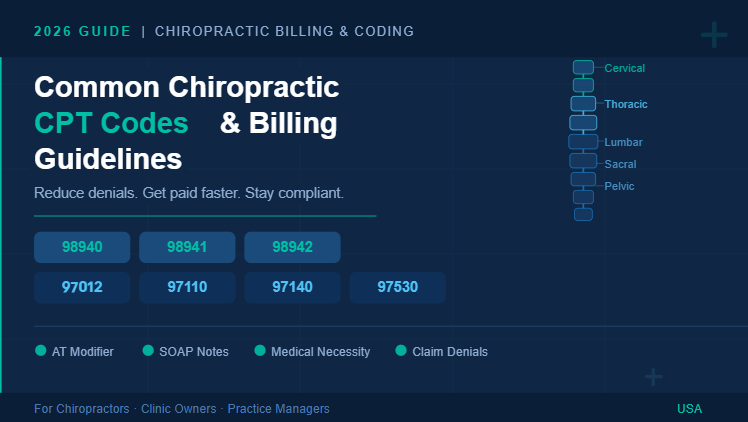
The five spinal regions are: cervical, thoracic, lumbar, sacral, and pelvic.
98940 – Chiropractic Manipulative Treatment (1–2 Spinal Regions)
Use this code when manipulation is performed on one or two spinal regions during a visit.
Example: A patient presents with isolated neck pain. You treat only the cervical spine — bill 98940.
This is one of the most commonly used chiropractic billing codes for straightforward, focused cases.
98941 – Chiropractic Manipulative Treatment (3–4 Spinal Regions)
Use this when treatment involves three or four spinal regions.
Example: A patient with mid and lower back pain receives manipulation to the thoracic, lumbar, and sacral regions — bill 98941.
This code reflects a more complex case and typically reimburses at a higher rate than 98940.
98942 – Chiropractic Manipulative Treatment (5 Spinal Regions)
This code is used when all five spinal regions are treated.
Example: A patient with full-spine involvement, such as post-accident cases, receives manipulation across all five regions — bill 98942.
Important: 98942 requires very clear and detailed documentation of medical necessity for all five regions. Without it, payers will deny the claim.
Adjunctive Therapy CPT Codes
Many chiropractic practices offer additional therapies beyond manipulation. These codes cover common adjunctive services:
97012 – Mechanical Traction
Used when a mechanical device applies traction to the spine or extremities.
Use case: Treating disc herniations, nerve compression, or degenerative joint conditions with a traction table.
Note: Time-based rules apply. Traction must be actively supervised and documented.
97110 – Therapeutic Exercises
Billed for therapeutic exercises designed to develop strength, endurance, range of motion, or coordination.
Use case: Patients in rehabilitation who perform guided exercises as part of their treatment plan.
Important: This is a timed code — typically billed in 15-minute increments. Document the specific exercises, time spent, and therapeutic goals.
97140 – Manual Therapy Techniques
Covers manual therapy procedures including mobilization, manual lymphatic drainage, myofascial release, and soft tissue work.
Use case: Treating joint stiffness or muscle tightness through hands-on techniques separate from CMT.
This code cannot be billed with 98940–98942 on the same anatomical region without a proper modifier.
97530 – Therapeutic Activities
Billed for dynamic activities designed to improve functional performance — balance, coordination, body mechanics.
Use case: Patients performing functional movement drills to support recovery and return to daily activities.
Like 97110, this is a timed code and requires detailed documentation of activities performed and time spent.
Key Billing Guidelines Chiropractors Must Follow in 2026
Understanding the codes is only half the battle. Here’s what the chiropractic billing guidelines require for clean claims:
Proper Documentation Is Non-Negotiable
Every service billed must be supported by documentation in the patient’s chart. This means:
- A clearly documented chief complaint
- Objective clinical findings (range of motion, orthopedic tests, palpation findings)
- A treatment plan with measurable goals
- Progress notes for every visit
If it’s not documented, it didn’t happen — and it won’t get paid.
Use the AT Modifier Correctly
The AT modifier (Active/Acute Treatment) is required by Medicare when billing chiropractic manipulative treatment codes (98940–98942). It signals that treatment is for an active, acute condition — not maintenance care.
Medicare does not cover maintenance care. Without the AT modifier on qualifying claims, Medicare will deny them automatically.
Always verify modifier requirements for each payer — commercial insurers may have different rules.
Establish and Document Medical Necessity
Payers want to see that the treatment being billed is medically necessary. This means:
- A clear diagnosis that supports the CPT codes billed
- Documented functional limitations
- Evidence of progress (or clinical justification if progress is slow)
Vague language like “patient continues care” is not enough. Be specific in your SOAP notes.
Follow Time-Based Coding Rules
For timed codes like 97110, 97140, and 97530, the AMA and CMS follow the 8-minute rule:
- A service must be performed for at least 8 minutes to bill one unit
- Each additional 15-minute block qualifies for an additional unit
Billing a timed code without documenting the actual time spent is a common audit trigger.
Write Complete SOAP Notes Every Visit
SOAP notes (Subjective, Objective, Assessment, Plan) are the backbone of chiropractic billing documentation. Every visit note should include:
- S: Patient’s reported symptoms and changes
- O: Objective findings from your examination
- A: Your clinical assessment and diagnosis
- P: Treatment provided and the plan going forward
Incomplete SOAP notes are one of the top reasons claims are denied or flagged during audits.
Common Mistakes in Chiropractic Coding
Even experienced practices make these errors. Here’s what to watch for:
- Selecting the wrong CMT code — billing 98941 when only two regions were treated is upcoding, which can lead to audits and repayment demands
- Missing the AT modifier on Medicare claims for manipulation
- Poor or incomplete documentation that doesn’t support the code billed
- Overcoding or undercoding — both create financial and compliance risk
- Not verifying individual payer rules — what works for BlueCross may not apply to Aetna or Medicare
- Billing 97140 and CMT codes on the same region without a separate supporting modifier
How Billing Errors Impact Your Practice Revenue
Every coding mistake has a financial consequence:
Claim Denials — Incorrect codes or missing modifiers result in outright claim rejections. Each denial requires staff time to review, correct, and resubmit.
Delayed Payments — Even claims that eventually get paid can be held up for weeks or months due to coding issues, stretching your cash flow.
Increased AR Days — A backlog of denied and pending claims inflates your accounts receivable and makes it harder to forecast monthly collections.
Revenue Leakage — Consistent undercoding means you’re providing services you’re not being paid for. Over months, this adds up to significant lost revenue.
Audit Risk — Patterns of upcoding or billing without adequate documentation can trigger payer audits, resulting in repayment demands and potential exclusion from networks.
Best Practices for Accurate Chiropractic Billing
Here’s how to build a billing process that protects your revenue:
Train Your Billing Staff Regularly Coding rules change every year. Make sure your front desk, billing team, and clinical staff are up to date on the latest CPT changes, modifier rules, and payer-specific requirements.
Conduct Routine Internal Audits Review a sample of claims each month to catch patterns of errors before they become costly. Internal audits are far less painful than payer audits.
Stay Updated on Payer Guidelines Each insurer — including Medicare — updates its coverage policies and billing requirements periodically. Assign someone on your team to monitor payer bulletins and policy changes.
Standardize Your Documentation Workflow Use templates for SOAP notes and encounter forms that prompt providers to capture all required information. When documentation is consistent, billing becomes more accurate.
Verify Insurance and Benefits Before Every Visit Confirming coverage and understanding each patient’s plan before treatment prevents claim surprises and helps set patient expectations for out-of-pocket costs.
Conclusion: Accurate Coding Is the Foundation of a Healthy Practice
Chiropractic CPT codes may seem like a back-office detail, but they directly impact your practice’s financial health, compliance standing, and long-term growth.
The difference between 98940 and 98941 isn’t just a number — it’s documentation, medical necessity, and thousands of dollars in reimbursement over the course of a year.
Getting it right means fewer denials, faster payments, and more time focusing on what matters most: patient care.
Take a moment to review your current billing and coding process. Are your SOAP notes thorough? Are your staff using the right modifiers? Are you verifying payer rules for each insurer you bill?
If you’re unsure whether your coding and billing process is fully optimized, a quick billing review can help identify gaps and improve your collections — before those gaps become costly.
Staying on top of chiropractic billing guidelines isn’t just good practice — it’s good business.