
If you run a pain management practice, you already know the frustration: a procedure goes well, documentation looks complete, and then weeks later, you get a denial. Again.
Pain management claim denials are one of the biggest revenue challenges facing practices in 2026. With payer rules tightening, prior authorization requirements expanding, and audit activity on the rise, even well-run practices are leaving significant money on the table.
The good news? Most denials are preventable. Understanding why they happen is the first step to stopping them.
Why Pain Management Billing Is Considered High-Risk
Pain management sits in one of the most scrutinized billing categories in all of healthcare. Payers view interventional procedures — epidural steroid injections, nerve blocks, radiofrequency ablation (RFA), spinal cord stimulation — as high-cost and frequently overutilized.
That scrutiny creates real billing risk for your practice.
Interventional Procedures Carry Extra Complexity
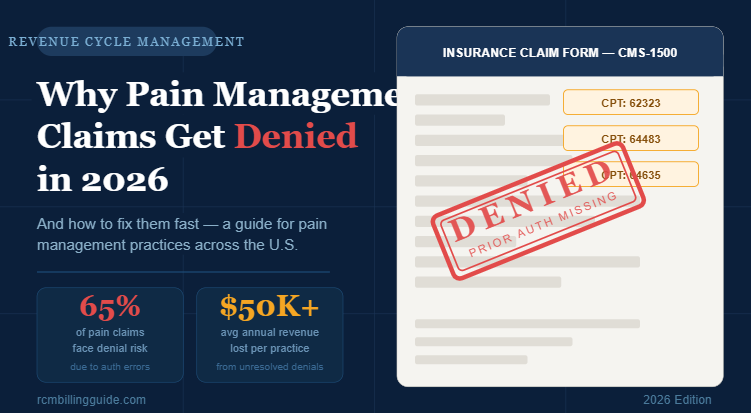
Procedures like epidural steroid injections (CPT 62323), lumbar facet joint injections (CPT 64483), and radiofrequency ablation (CPT 64635) each come with their own sets of payer policies, frequency limits, and medical necessity requirements.
A single missing element in the claim or chart note can result in an instant denial.
Payer Guidelines Change Frequently
Commercial payers, Medicare, and Medicaid each have their own clinical coverage policies — and they update them regularly. What was reimbursable last year may require additional documentation or a new authorization step in 2026.
Prior Authorization Is Everywhere
Nearly every interventional pain procedure requires prior authorization from at least some payers. Managing these requests manually, tracking expiration dates, and confirming procedure-specific approvals is a constant operational burden.
High Audit Risk
Pain management practices are routinely targeted in payer audits and RAC (Recovery Audit Contractor) reviews. Incomplete documentation or inconsistent coding can trigger repayment demands that go back years.
Most Common Reasons for Pain Management Claim Denials
Understanding the patterns behind denials helps you fix the root cause, not just appeal case by case. Here are the most frequent reasons pain management claims get denied in 2026:
1. Missing or Incorrect Prior Authorization
This is the number one reason for denials. If a procedure is performed without a valid authorization — or with an authorization for the wrong procedure code or body region — the claim will be denied, often with no appeal path.
Common mistakes include:
- Authorization obtained for one spinal level but procedure performed at a different level
- Expired authorization at the time of service
- Authorization not confirmed for the specific CPT code billed
2. Incorrect CPT Code Selection
Pain management CPT coding is highly specific. A single digit error can result in a denial or a significant underpayment.
Common coding errors include:
- Billing CPT 62322 (without imaging) when 62323 (with imaging guidance) was performed
- Confusing unilateral vs. bilateral codes for nerve blocks
- Billing the wrong level for spinal procedures (cervical vs. lumbar vs. thoracic)
3. Insufficient Documentation
Payers require documentation that proves medical necessity — not just that a procedure was performed. If your procedure notes don’t connect the diagnosis to the clinical rationale for treatment, expect a denial.
Documentation gaps that trigger denials:
- No failed conservative treatment documented prior to interventional care
- Missing fluoroscopy or imaging reports
- Procedure notes that don’t match the CPT code billed
4. Incorrect Modifier Usage
Modifiers provide critical context to payers. Using the wrong modifier — or forgetting one entirely — can cause a claim to deny or pay incorrectly.
Examples include:
- Failing to append Modifier 50 for bilateral procedures
- Missing Modifier 59 or X{EPSU} modifiers to distinguish separate services
- Incorrect use of Modifier 76 for repeat procedures
5. Bundling and Unbundling Errors
Some pain management procedures are bundled under the National Correct Coding Initiative (NCCI). Billing them separately can result in denial. Conversely, failing to separately bill legitimately distinct services results in lost revenue.
Both errors are more common than most practices realize.
6. Eligibility and Coverage Issues
Verifying eligibility sounds basic, but coverage gaps — lapsed insurance, incorrect plan information, out-of-network issues — remain a significant source of denials that go undetected until claims return rejected.
The Real Impact on Your Practice
Every denied claim has a downstream cost that goes beyond just that one unpaid service.
Delayed payments stretch your accounts receivable (AR) days, putting pressure on cash flow — especially in smaller practices.
Revenue leakage happens when denials are never appealed, or when corrected claims are resubmitted too late. Studies consistently show that a large percentage of denied claims are never reworked at all.
Increased staff workload means your team spends hours on rework, appeals, and follow-up instead of managing new claims or improving front-end processes.
Audit exposure grows when denial patterns signal to payers that coding or documentation practices may be inconsistent.
The bottom line: pain management claim denials don’t just delay revenue — they erode it permanently if left unaddressed.
How to Fix Pain Management Claim Denials Fast
The practices that reduce denial rates fastest share one thing in common: they address problems at the source rather than relying on appeals to recover lost revenue.
Verify Authorization Before Every Procedure
Build a pre-authorization workflow that confirms:
- The correct procedure code is authorized
- The correct body region or spinal level is covered
- The authorization is still active on the date of service
Don’t rely on memory or verbal confirmation alone. Document everything in the patient’s file.
Strengthen Your Clinical Documentation
Work with your providers to make sure procedure notes consistently include:
- The clinical rationale and diagnosis supporting the procedure
- Documentation of prior conservative treatment (especially for interventional procedures)
- Imaging or fluoroscopy reports when applicable
- The specific technique, approach, and level treated
This documentation doesn’t just prevent denials — it protects you in an audit.
Use Correct CPT Codes and Modifiers
Invest in a pain management-specific coding reference and review your most frequently billed codes regularly. Confirm that:
- The right CPT code is selected for the procedure as performed
- Imaging guidance is captured correctly
- Modifiers are applied consistently and correctly
Track Payer-Specific Rules
Medicare, Blue Cross, Aetna, and United all have different policies for the same procedure. Maintain a payer matrix for your top 5–10 payers that documents authorization requirements, frequency limits, and documentation expectations for your most common CPT codes.
Strengthen AR Follow-Up
Set a standard for how quickly denied claims are reviewed and reworked. A 48–72 hour review window for new denials is a practical target for most practices. Assign ownership so denials don’t fall through the cracks.
Best Practices for Pain Management Billing in 2026
Building a more resilient billing process means going beyond fixing individual denials. Here’s what high-performing pain management practices are doing differently:
Regular billing audits. Conduct quarterly internal audits of your top 10 CPT codes to check coding accuracy, modifier usage, and documentation consistency before payers find the problems.
Ongoing staff training. Pain management coding changes every year. Schedule regular training for billing staff and front-desk teams on authorization workflows, eligibility verification, and payer updates.
Denial trend monitoring. Track denials by reason code, payer, and CPT code. Patterns in your denial data reveal systemic problems that can be fixed at the process level.
Structured billing workflows. Standardize how claims move from charge capture to submission. Clear workflows reduce the chance that steps — like attaching operative notes or confirming auth numbers — get skipped under high volume.
Conclusion: Accurate Billing Protects Your Revenue and Your Practice
Pain management billing will only get more complex as payers tighten policies and audit activity increases. But most pain management claim denials are preventable with the right processes, documentation habits, and coding accuracy.
Practices that invest in proactive billing improvement — rather than waiting to appeal denials — consistently recover more revenue, shorten AR days, and reduce the operational burden on their teams.
The first step is understanding where your gaps are.
If you’re unsure why your claims are getting denied, a quick billing review can help identify gaps and improve collections. A focused review of your top denial reasons, authorization workflows, and documentation practices can reveal opportunities to recover revenue you may not realize you’re losing.