Most practices treat payment posting as a bookkeeping function. Record what came in, move on. It isn’t.
Payment posting is the step in the revenue cycle where you find out whether you were actually paid correctly or whether your practice accepted less than it was owed and recorded that shortfall as a write-off without anyone questioning it. (Payment Posting Services)
Payer underpayments are not rare exceptions. They are a systematic and ongoing feature of medical billing. Insurers apply contractual adjustments incorrectly. Multiple procedure reductions exceed contracted percentages. Payments are posted to the wrong charge line. Secondary claims go unpaid because the primary EOB was never forwarded. And without payment posting that reconciles every remittance against the contracted fee schedule line by line, claim by claim these underpayments become permanent write-offs that compound month after month.
At Malakos Healthcare Solutions, we provide payment posting services that go beyond data entry. Every payment received is posted accurately, reconciled against your contracted rates, and reviewed for variance. Underpayments are identified and appealed before they are written off. Secondary claims are submitted promptly after primary adjudication. Patient balances are calculated correctly and communicated clearly. And your practice maintains a real-time, accurate picture of every dollar it has collected and every dollar still owed.
Why Payment Posting Is More Than Data Entry
Payment posting sits at the intersection of collections accuracy and revenue intelligence. Done at a data entry level posting what arrived without analyzing whether it was correct it produces accurate-looking financial records that may be systematically understating what your practice actually earned.
Done correctly, payment posting is an active revenue protection function that catches underpayments before they’re written off, triggers secondary billing at the right moment, feeds accurate data into AR follow-up workflows, and produces the financial intelligence your practice needs to understand its true revenue performance.
The Underpayment Problem Most Practices Don’t Know They Have
Every payer contract specifies the rates your practice will be paid for specific services the fee schedule allowable. When a payer pays less than the contracted allowable, that is an underpayment. It is your money, it is contractually owed, and it can be appealed.
The problem is that most underpayments are invisible unless someone is actively looking for them. When a payment is posted and the balance is written off to “contractual adjustment” without verifying that the payment matches the contracted rate the underpayment disappears from the system as if it never existed.
Common sources of payer underpayment:
Incorrect contractual adjustment amounts – The payer applies a contractual adjustment that reduces the payment below the contracted rate. If the adjustment amount isn’t reconciled against the fee schedule, it’s accepted and written off.
Multiple procedure reductions applied at incorrect percentages – When multiple procedures are performed in a single visit, payers apply reimbursement reductions to secondary and tertiary procedures typically 50% for Medicare, with commercial payer percentages varying by contract. When a payer applies a 60% reduction on a contract that specifies 50%, the extra 10% is an underpayment on every qualifying claim.
Bundled payment for separately billable services – When a payer processes two separately billable services as a single bundled payment, the difference between what was paid and what was owed for both services is an underpayment. This most commonly occurs when Modifier 25 or Modifier 59 is present but the payer bundles regardless.
Incorrect fee schedule applied – When a payer applies a fee schedule that predates a contract update, or applies a non-contracted rate to a credentialed provider, every claim paid under that fee schedule is potentially underpaid.
Downcoded payments – When a payer reimburses a lower-level E/M code than was billed, without issuing a formal denial, the difference between the billed level and the paid level is an underpayment that requires an appeal not a write-off.
Missing secondary payer payments – When a patient has secondary insurance that would cover all or part of the patient responsibility remaining after primary adjudication, and the secondary claim is never submitted or is submitted without the primary EOB, the secondary payment is permanently lost.
What Payment Posting Actually Involves
EOB and ERA Processing
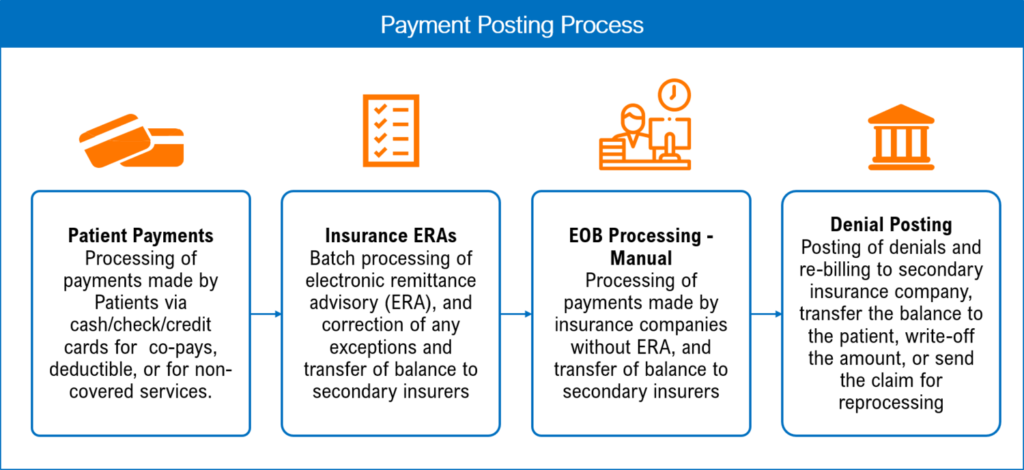
Payments arrive from payers in two formats: paper Explanation of Benefits (EOB) statements and electronic Electronic Remittance Advice (ERA) files transmitted via EDI 835 transaction. Each format carries the same information what was billed, what was allowed, what contractual adjustments were applied, what was paid, and what patient responsibility remains but requires different processing workflows.
ERA (Electronic Remittance Advice): ERA files are automatically matchable to the corresponding claims in most practice management systems. They contain structured data that enables efficient bulk posting and automated contractual adjustment application. We configure ERA auto-posting rules for recurring, predictable payment patterns while maintaining manual review for variance flags.
EOB (Explanation of Benefits): Paper EOBs require manual review and entry each service line verified against the claim and posted individually. EOB processing is more time-intensive than ERA but equally important, particularly for payers that still remit paper or for edge cases where ERA transmission fails.
Both formats are processed promptly payment posting delays extend days-in-AR unnecessarily and create reconciliation backlogs that become difficult to unwind.
Contractual Adjustment Application
Contractual adjustments are the difference between the billed charge and the payer’s contracted allowable the amount your practice has agreed to write off per the payer contract. Applying these adjustments correctly is a compliance and accuracy function.
The key distinction: contractual adjustments are write-offs your practice agreed to. Underpayments are write-offs your practice did not agree to. The two look identical in a payment posting workflow that doesn’t reconcile against contracted rates both show up as adjustments reducing the balance to zero. Only active rate verification distinguishes between them.
We apply contractual adjustments based on verified contracted rates by payer and procedure not as blanket write-offs. When the payment plus adjustment doesn’t reconcile to the contracted allowable, the difference is flagged as a variance for review rather than written off automatically.
Payment-to-Claim Matching
Every payment is matched to the correct patient account, the correct date of service, and the correct charge line before posting. Misapplied payments posted to the wrong patient, the wrong date of service, or the wrong procedure create reconciliation errors that surface later as unexplained balances, duplicate payments, or patient billing disputes.
In high-volume practices receiving hundreds of ERA lines per day, accurate payment-to-claim matching requires structured workflows and active exception handling for claims that don’t auto-match cleanly.
Underpayment Identification and Appeal
This is the function that separates active payment posting from passive data entry.
We reconcile every posted payment against your contracted fee schedule for each payer. When the payment falls below the contracted allowable after appropriate contractual adjustments the variance is documented and flagged for appeal. Our underpayment appeal process includes:
- Identifying the specific payment line and the contractual basis for the expected amount
- Pulling the relevant contract terms and fee schedule documentation
- Submitting a formal underpayment dispute to the payer with supporting documentation
- Tracking the dispute through resolution
- Posting the corrected payment when the appeal is successful
Underpayment appeals have meaningful recovery rates when pursued promptly with contract documentation. Appeals filed 90+ days after the original payment are significantly less successful which is why underpayment identification must happen at the payment posting stage, not during an annual audit.
Secondary and Tertiary Claim Submission
When primary adjudication produces a patient responsibility balance and the patient has secondary insurance, the secondary claim must be submitted promptly with the primary payer’s EOB attached. We track COB (Coordination of Benefits) status for every patient with multiple payers and trigger secondary claim submission automatically after primary payment posting.
Secondary claim submission is one of the most consistently missed revenue functions in practices without a structured COB workflow. Patient balances that should be covered by secondary insurance become patient bills creating collection friction and patient relations issues that are entirely preventable.
Patient Balance Calculation and Statement Generation
After all payer adjudication is complete, the remaining patient responsibility co-pays, deductibles, co-insurance, non-covered service balances is calculated accurately and communicated to the patient. We generate clear patient statements that reflect what was billed, what insurance paid, what adjustments were applied, and what the patient owes with a clear explanation of each balance component.
Accurate patient balance calculation depends on accurate payment posting. When payer payments are posted incorrectly, patient responsibility is miscalculated resulting in either over-billing (creating disputes and refund requests) or under-billing (leaving patient responsibility uncollected).
Daily Reconciliation and Deposit Matching
Every payment posted is reconciled against the bank deposit for that day. Posted payment totals must balance against actual deposit amounts discrepancies indicate either posting errors or undeposited payments that need to be located. We perform daily reconciliation as a standard workflow step, maintaining a clean audit trail between posted payments and bank deposits.
Payment Posting Errors That Cost Practices Revenue
Posting payments without fee schedule verification – The most expensive systematic error in payment posting. Every underpayment that isn’t caught at posting is written off permanently.
Blanket contractual adjustment write-offs – Applying a standard write-off percentage or flat amount to all claims from a payer, rather than applying the specific contracted rate per procedure. This approach permanently obscures underpayment variances.
Delayed posting that backs up AR follow-up – When payment posting is delayed by days or weeks, AR follow-up teams are chasing claims that have already been paid. The result is wasted follow-up effort and an AR aging report that doesn’t reflect actual outstanding balances.
Misapplied patient payments – Co-pays and patient balance payments posted to the wrong account, the wrong visit, or the wrong charge line create reconciliation problems that are time-consuming to unwind and can result in incorrect patient statements.
Missing secondary claim trigger – When the secondary claim submission workflow isn’t linked to primary payment posting, secondary claims are submitted late, missed entirely, or submitted without the primary EOB resulting in secondary payer denials.
Incorrect adjustment codes – Using the wrong CARC (Claim Adjustment Reason Code) or RARC (Remittance Advice Remark Code) when posting adjustments obscures the actual reason for a payment reduction and makes denial and underpayment pattern analysis unreliable.
Write-off of downcoded payments – When a payer pays a lower E/M level than billed without issuing a formal denial, posting the payment and writing off the balance difference as a contractual adjustment is incorrect. The difference is an underpayment, not a contractual write-off, and is subject to appeal.
Remittance Codes We Monitor – CARC and RARC
Understanding the reason codes on every remittance is essential for accurate payment posting and denial/underpayment identification. We track and interpret Claim Adjustment Reason Codes (CARC) and Remittance Advice Remark Codes (RARC) on every posted payment.
Key CARC categories we monitor:
- CO (Contractual Obligation) – Write-offs per payer contract; must be verified against contracted rates before applying
- PR (Patient Responsibility) – Co-pay, deductible, co-insurance amounts transferred to patient balance
- OA (Other Adjustment) – Adjustments not covered by CO or PR; often requires investigation
- PI (Payer Initiated Reduction) – Payer-initiated reductions that may or may not be contractually justified
Common CARC codes that flag review:
| CARC Code | Description | Payment Posting Action |
|---|---|---|
| 45 | Charge exceeds fee schedule/maximum allowable | Verify against contracted rate – if payment is below contracted allowable, flag for appeal |
| 97 | Payment included in allowance for another service/procedure | Bundling – verify whether Modifier 59 or 25 was present; may be underpayment |
| 4 | Service dates not consistent with admission dates | Date of service mismatch – verify against clinical record |
| 16 | Claim lacks required information | Missing data denial – identify and resubmit with complete information |
| 18 | Exact duplicate claim/service | Duplicate flag – verify whether claim was submitted twice; do not resubmit if payment already received |
| 22 | Payment adjusted because this service/procedure was furnished in combination with another service | Multiple procedure reduction – verify reduction percentage against contracted rate |
| 24 | Payment adjusted because charges have been paid by another payer | COB – verify primary payment amount and submit secondary claim if applicable |
| 253 | Sequencing of therapy services is incorrect | Time-based service order – review therapy notes and resubmit with corrected sequencing |
What Our Payment Posting Process Covers
Step 1 – Daily remittance retrieval. We retrieve ERA files and EOBs daily from all active payers. No payment sits unprocessed for more than one business day.
Step 2 – Payment-to-claim matching. Every payment is matched to the correct patient account, date of service, and charge line before posting. Unmatched payments are flagged and investigated not posted to suspense accounts and forgotten.
Step 3 – Contracted rate verification. Before posting any contractual adjustment, we verify the payment against the contracted fee schedule for that payer and procedure. Variances are flagged for review rather than written off automatically.
Step 4 – Adjustment posting with correct CARC/RARC codes. Contractual adjustments, patient responsibility transfers, and other adjustments are posted with the correct reason codes maintaining a clean audit trail and enabling accurate denial and underpayment pattern analysis.
Step 5 – Underpayment flagging and appeal initiation. Payment variances that fall below contracted rates are documented and escalated for appeal. Our underpayment recovery workflow handles appeal submission, follow-up, and corrected payment posting through to resolution.
Step 6 – Secondary claim trigger. When primary adjudication produces patient responsibility and the patient has secondary insurance, the secondary claim is submitted with primary EOB within one business day of primary payment posting.
Step 7 – Patient balance calculation. Patient responsibility is calculated accurately after all payer adjudication and posted to the patient account for statement generation.
Step 8 – Daily reconciliation. Posted payment totals are reconciled against bank deposits daily. Discrepancies are investigated and resolved before the next business day.
What Accurate Payment Posting Delivers
Underpayment recovery. Active fee schedule reconciliation identifies underpayments that passive posting misses entirely. For practices billing high-volume specialties with multiple procedure reductions pain management, physical therapy, interventional procedures underpayment recovery from a single month of active posting can be material.
Accurate AR aging. When payments are posted promptly and accurately, AR aging reflects what is actually outstanding not a mix of paid and unpaid claims that haven’t been reconciled. Accurate AR data drives more effective follow-up.
Clean financial reporting. Monthly collections reports, payer-level performance analysis, and revenue trend data are only as accurate as the payment posting that underlies them. Posting errors create financial reporting noise that makes revenue management decisions unreliable.
Correct patient statements. Patients receive accurate statements that reflect what insurance paid and what they actually owe reducing disputes, reducing refund requests, and improving collection rates on patient balances.
Compliance audit trail. Every posted payment has a documented reason code, a source remittance, and a reconciliation record. When payers audit claims or request payment documentation, a clean posting record is essential.
Why Practices Choose Malakos Healthcare Solutions for Payment Posting
Active underpayment recovery, not passive posting. We reconcile every payment against contracted rates. Underpayments are identified at posting, not discovered in an annual audit when recovery is far more difficult.
Same-day or next-day posting. Payments are posted within one business day of receipt. No backlog, no delay, no AR aging distortion from unposted remittances.
CARC/RARC intelligence. We interpret every remittance reason code and use denial and payment patterns to identify systemic payer issues underpayment patterns, bundling behavior, downcoding trends and escalate them appropriately.
Secondary claim workflow integration. Secondary claims are triggered automatically from primary payment posting. No COB revenue is left uncollected due to workflow gaps.
HIPAA-compliant operations. All data handling follows strict HIPAA protocols. A Business Associate Agreement (BAA) is included with every engagement.
Monthly payment performance reporting. You receive monthly reports covering collections by payer, payment variance analysis, underpayment recovery amounts, adjustment distribution by CARC category, and secondary claim collections. Full visibility into every payment your practice received and every payment it should have received.
Frequently Asked Questions – Payment Posting
What is the difference between an EOB and an ERA? An Explanation of Benefits (EOB) is a paper or PDF document sent by the payer explaining how a claim was processed what was billed, what was allowed, what adjustments were applied, and what was paid. An Electronic Remittance Advice (ERA) is the electronic equivalent an EDI 835 transaction that carries the same information in a structured format that can be auto-matched and posted by practice management systems. Both contain the same payment information; ERAs are more efficient to process and enable automated posting workflows. We process both formats and configure ERA auto-posting where appropriate.
What is a contractual adjustment and how is it different from an underpayment? A contractual adjustment is the difference between your billed charge and the payer’s contracted allowable the amount you agreed to write off per your payer contract. It is a legitimate, expected write-off. An underpayment is when the payer pays less than the contracted allowable less than you are contractually owed. Both appear as adjustments in a payment posting workflow that doesn’t reconcile against contracted rates. Active fee schedule verification at posting is the only way to distinguish between them and prevent underpayments from being written off as contractual adjustments.
How do you identify and appeal underpayments? We reconcile every posted payment against the contracted fee schedule for that payer and procedure. When the payment falls below the contracted allowable after applicable adjustments, we document the variance, pull the relevant contract terms, and submit a formal underpayment dispute to the payer with supporting documentation. Underpayment appeals are tracked through resolution and corrected payments are posted when received. The key is acting promptly underpayment appeal success rates decline significantly as time passes from the original payment date.
What happens to secondary insurance claims in your workflow? Secondary claim submission is integrated into our primary payment posting workflow. When primary adjudication produces a patient responsibility balance and the patient has secondary insurance, we trigger the secondary claim submission within one business day of primary payment posting with the primary EOB attached. We track COB status for every patient with multiple payers and ensure secondary claims are submitted correctly and followed up if not adjudicated within expected timelines.
How does delayed payment posting affect AR follow-up? AR follow-up teams work from aging reports lists of claims that appear to be outstanding based on what’s been posted. When payment posting is delayed, paid claims appear as open AR, and follow-up staff waste time contacting payers about claims that have already been paid. More importantly, actual outstanding claims get less attention because the AR queue is inflated with false positives. Prompt daily posting keeps AR aging accurate and follow-up effort focused on genuinely unpaid claims.
How quickly can we get started? Most practices are fully onboarded within 7-14 business days. We begin with a review of your current payment posting workflow, contracted fee schedules by payer, ERA enrollment status, and COB tracking process. For practices with posting backlogs, we address the backlog as part of onboarding not after. Transition runs in parallel with your existing process with no disruption to billing or cash flow.
Ready to Stop Writing Off Revenue You’re Actually Owed?
If your practice is posting payments without fee schedule verification, missing underpayments, skipping secondary claims, or dealing with a posting backlog that’s distorting your AR we can fix it.
A free billing audit will show you exactly how much your practice is leaving on the table in underpayments and unpursued secondary claims.
Schedule Your Free Billing Audit
📞 +1 (307) 441-3431 ✉️ support@malakoshcs.com
Explore Our Full RCM Service Suite
- Eligibility & Benefit Verification
- Medical Coding Services
- Charge Entry
- Claims Submission
- Denial Management
- AR Follow Up
Malakos Healthcare Solutions | Payment Posting Services USA | Supporting independent practices and specialty groups nationwide